November 29, 2020

Gryphon ‎– Raindance (1975, LP, England)


Label: Transatlantic Records - TRA 302
Official DR value: DR12 (see details)

Side 1
A1 - Down The Dog  2:44
 A2 - Raindance  5:37
A3 - Mother Nature's Son  3:08
A4 - "Le Cabrioleur Est Dans Le Mouchoir" 2:14
A5 - Ormolu  1:00
A6 - Fontinental Versionr  5:36
Side 2
B1 - Wallbanger  3:33
B2 - Don't Say Go  1:48
B3 - (Ein Klein) Heldenleben  16:03

Musicians:
Bass, Flute - Malcolm Bennett 
Bassoon, Backing Vocals - Brian Gulland 
Clarinet - Richard Harvey (tracks: A4) 
Drums, Percussion - Dave Oberlé 
Grand Piano, Electric Piano [Rhodes, Rmi, Crumar], Synthesizer [Mini-moog], Organ [Copeman Hart], Mellotron, Clavinet, Glockenspiel [Keyboard Glockenspiel], Recorder, Crumhorn, Tin Whistle [Penny] - Richard Harvey  
Guitar, Backing Vocals - Graeme Taylor 
Lead Vocals - Dave Oberlé (tracks: A3, B2) 
Vocals - Brian Gulland (tracks: A6), Dave Oberlé (tracks: A6)

Albert Marcœur ‎– Album À Colorier (1976, CD, France)


This was the fantastic 2nd album by Albert, which, like his first, was originally released on French Atlantic. A brilliant musician, composer and arranger, the closest comparison one can make is that Albert is the French Frank Zappa, except that that doesn't really do Albert or his original music justice.Coming just two years after his first (the shortest time between albums Albert has ever managed - he works carefully and SLOWLY), this might have been slightly overlooked by folks. Don't make that same mistake now; this is a stupendous album with great melodies, musical surprises galore, brilliant orchestration and much more. He had a big budget and big ideas on this outing, and this comes highly recommended. (wayside)

Flairck ‎– Bal Masqué (1984, LP, Netherlands)

Tracklist:
A1. Ouverture  2:49
A2. De Gravin  3:25
A3. Presto de l'estate  2:44
A4. Inventies (de ivoren toren)  6:41
A5. De Derde Wals  5:44
B1. Tango & Les Riches  9:07
B2. Het Debat  2:46
B3. Nocturne  3:45
B4. Reprise  2:40
B5. De Amsterdamse Grachten  2:25

Musicians:
Choir – Koor Van De Kerkmuziekschool Te Utrecht
Chorus Master – Jan Stulen
Concertmaster – Jenö Nemeth
Contrabass, Cello, Organ, Harmonium, Vocals [Choir Vocals] – Dirk van Gorp
Flute [Transverse Flute], Piccolo Flute, Alto Saxophone, Soprano Saxophone, Accordion, Lead Vocals, Vocals [Choir Vocals] – Cornee Van Der Kleij
Guitar [6-String], Twelve-String Guitar, Resonator Guitar, Bouzouki, Banjo, Vocals [Choir Vocals] – Erik Visser
Orchestra – Noord-Hollands Philharmonisch Orkest
Tabla, Marimba, Percussion, Timpani, Vocals [Choir Vocals], Voice [Tabla Vocals] – Ted De Jong
Violin, Viola, Harp, Vocals [Choir Vocals] – Sylvia Houtzager


Originally Bal Masqué was written as an instrumental opera for Flairck and balletdancers. The first performances took place during a Dutch-Belgian tour in the spring of 1984. The libretto of this piece is based on the idea of a masqued ball with a number of important guests, who are staying in a place which is shut off from the outside world because of approaching danger. Apart from an overture and a reprise the music consists of various dances or acts in which one or more of the guests come to the foreground. When, after the Overture, all the guests have arrived, the hostess steps forward in a piece called The Countess. Presto da l'Estate (the third part of the Summer of the Four Seasons by A. Vivaldi) is part of the music played by the musicians at the ball. Inventions (part 1 the Ivory Tower, part 2 Eureka) is the dance of a General and The Rich (a song written by G. Moustaki) is about all the guests. The Debate is the story of a politician and Nocturne is a description of the end of a party. The piece ends with a Reprise of the opening theme.

November 28, 2020

Brimstone ‎– Paper Winged Dreams (1973, LP, Usa)


Tracklist:
1. Dead Sleep At Night (3:12)
2. End Of The Road (3:55)
3. Etude / Fields Of Clay (6:17)
4. Illusion / Paper Winged Dreams (4:51)
5. Suite In Five Movements (18:52) :
- I Prelude In C Minor
- II Song Of Fifths (Thanks To Our Friend)
- III Interlude To You
- IV Ode To Fear And Loneliness
- V Epilogue: Forever

Musicians:
Gregg Andrews / vocals
Christopher Wintrip / electric, acoustic & Classical guitars, vocals
Bernie Nau / Hammond, grand piano, ARP synth, clarinet, vocals
Ken Miller / bass, vocals
Jimmy Papatoukakis / percussion, vocals


Paper Winged Dreams was the only studio album by this US prog rock band. Brimstone plays a quite melodic and keyboard driven form of progressive rock with some minor psychedelic elements here and there. The A-side of the album includes four shorter tracks whereas the B-side is filled with the massive almost 19 minutes long "Suite in Five Movements". The B-side is the standout moment here although the shorter songs are interesting as well. Nothing outstanding though.
Recommended for the fans of symphonic and melodic prog. I'm not a fan of this album but it's a decent effort. The original private pressing is quite rare and the album hasn't been officially reissued on vinyl yet which is kinda odd. (cooperbolan)

Alvaro "Jumbo" Fella, Consorzio Acqua Potabile ‎– Coraggio E Mistero (2016, CD, Italy)

Coraggio e mistero
Songs:
1. Coraggio E Mistero (12:01)
2. Il Cervo E La Fonte (7:01)
3. Io Ti Canto (6:13)
4. La Strada (6:33)
5. Ciao Alvaro (Dove Vai?) (4:33)
6. Sette E Trenta (di Mattina) (5:44)
7. Tra Le Scale E Il Cielo (9:26)
8. Le Sette Stanze Di Dimitrji (14:58) (vinyl only)
9. La Notte E Il Mulino Di Al (21:10)

Musicians:
Alvaro Fella (Jumbo) / lead vocals
Maurizio Mercandino / vocals, guitar
Chicco Mercandino / guitar
Massimo Gorlezza / guitar
Silvia Carpo / vocals, medieval flutes
Enrico Venegoni / Mellotron, keyboards
Maurizio Venegoni / Minimoog , keyboards, woodwinds
Luigi "Gigi" Secco / bass
Maurizio "Mux" Mussolin / drums
Guido Dipierro / electric guitar
Sergio Conte / keyboards


Consorzio Acqua Potabile (CAP) is an Italian progressive band that formed in the 70s, eventually releasing a handful of albums starting in the 90s. For their latest they teamed with Alvaro “Jumbo” Fella, vocalist for the short lived 70s Italian prog band Jumbo. To rejuvenate the band, Alvaro tasked CAP with writing songs about Courage and Mystery, hence the album title. The result is eight songs, most of them featuring Alvaro’s raspy vocals. I am unfamiliar with CAP’s previous albums, so I am at a disadvantage when it comes to comparing Coraggio e Mistero to their earlier work. What I can say is despite the intricate arrangements, use of vintage instruments, and Italian prog themes, I find their music somewhat off-putting. I really cannot put my finger on why. Perhaps there are too many shifts in focus, or the melody lines do not engage me, or perhaps it is Alvaro’s vocals. Also the cover art belies the listening experience. I was expecting something fantastical, gentle, and bucolic. The only track that I did find interesting is the mammoth 21 minute “La Notte e il Mulino di Al.” This dark song features lots of organ and guitar interplay, different movements, an acoustic guitar and flute interlude, and ends with sounds of women meowing, screaming, and evil laughter. Of course, no Italian prog album would be complete without a liberal dose of Mellotron and occasional jazzy vibes. Another track, “Tra le Scale e il Cielo,” approaches theatrical prog, similar to Osanna. This album may improve on repeated listenings and be an acquired taste. (exposé)

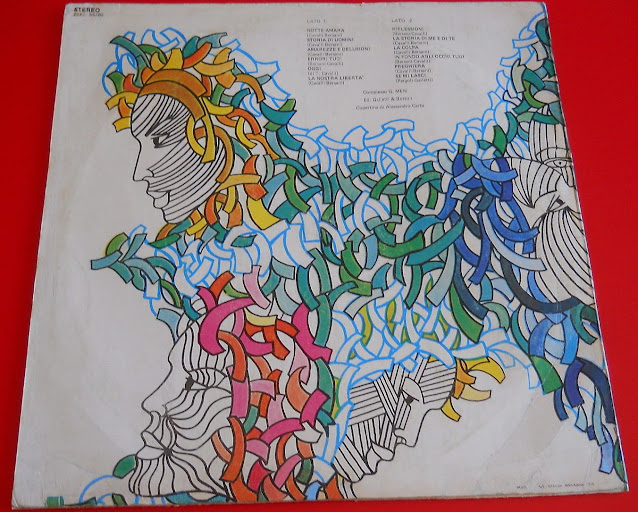
G. Men ‎– Oggi (1975, LP, Italy)


Tracklist:
A1 Notte Amara
A2 Storia Di Uomini
A3 Amarezze E Delusioni
A4 Errori Tuoi
A5 Oggi
A6 La Nostra Libertà
B1 Riflessioni
B2 La Storia Di Me E Te
B3 La Colpa
B4 In Fondo Agli Occhi Tuoi
B5 Preghiera
B6 Se Mi Lasci

November 20, 2020

Franco Mussida ‎– Racconti Della Tenda Rossa (1991, CD, Italy)

Tracklist:
1. Voci (1:44)
2. Orizzonyi Del Cuore (3:30)
3. Radici Di Terra (4:34)
4. La Cava Di Sabbia (5:22)
5. Himalaya (5:35)
6. Dance Classique (3:00)
7. La Tempesta (1:40)
8. La Discesa Di Michele (5:20)
9. Porti Lontani (1:20)
10. Zanoobia (5:24)
11. Tenda Rossa (4:29)
12. Caffè Concerto (1:30)

Musicians:
Franco Mussida / guitars, bass, keyboards & vocals
Massimo Longhi / keyboards
Attilio Zanchi / bass
Stafano Grasso / electric drums
Paolo Bolio / keyboards
Fabio Concato / vocals
Angelo Branduardi / vocals
Gianni Nocenzi / keyboards & violin
Mauro Gnecchi / percussion
Jon Driver / vocals
Pietro Stefanoni / drums
Naco / percussion
Tino Tracanna / saxes
Daniela Rando / vocals
Antonia Gidiuli / vocals
Cristian Mayer / alto sax
Giancarlo Parisi / sax, flute & bagpipes
Tony Mims / keyboards

Morse Code ‎– Je Suis Le Temps (1977, CD, Canada)

Bruce Ditmas ‎– Aeray Dust (1977, LP, Usa)


Tracklist:
A1. Aeray Dust  6:33
A2. Side Looking Radar Image  7:15
A3. Terminal Velocity  3:54
B1. Face To Face To Face  7:10
B2. Tactics Of Despair  2:54
B3. That's The Way It Is  9:40

Musicians:
Composed By, Drums, Drum Machine [Moog Drum], Synthesizer [Mini-moog, Arp 2600], Percussion – Bruce Ditmas
Trumpet – Enrico Rava
Voice, Percussion – Joan La Barbara


As an artist whose name has become mutually synonymous with the instrument he plays Bruce Ditmas is a very unique heavy musician from one of those special tight knit communities that tried (and almost succeeded) to change the facade of progressive pop music and jazz via musical technology. Raised in Miami (an unknown incubator for future synthesists) Bruce carved the image of a teen prodigy playing jazz drums at the most exclusive Miami Beach hotels. After being whisked off to New York by none other that July Garland he became immersed in free music, recording compositions by Annette Peacock and Carla Bley before setting up house with vocal artist Joan La Barbara (later Mrs. Morton Subotnick) in 1975, who, via her own label, encouraged Bruce to pursue his very specific experiments in heavy electronic rhythms.

This LP is compiled from the solo Moog Drum compositions from his only two albums both released in 1977 using a Mini-Moog (donated by Gil “Hendrix” Evans), an Arp 2600 and a wide range of treated percussive instruments that littered this enfant terrible’s bedroom floor throughout the 1970s. A later pillar of the Enja and ECM community, Bruce's later work in TV, film, sound sculpture and free music still renders truly unique recording to this very day. Meet your new favourite drummer, and the best Moog Drum record in your whole collection.

November 15, 2020

Verdaguer ‎– Humahuaca (1994, CD, Brazil)

Tracklist:
1. Danca Dos Dedos (3:56)
2. Nova Espanha (6:11)
3. Charara (4:33)
4. Humahuaca (5:15)
5. Pulomelu (10:46)
6. Galho De Arruda (5:29)
7. Montanhas (5:06)
8. Jogo Da Memoria (7:37)
9. Rara Vez (6:29)

Musicians:
Willy Verdaguer / bass, arrangements
Billy Bond / vocals (4,9)
Marcelo Pizzarro / guitar
Tadeu Passarelli / keyboards
Luiz De Boni / MiniMoog (4)
Marcelo Mig / flute
Derico Sciotti / sax
Gilberto Faveri / drums
Eduardo Avena / percussion


Willy Verdaguer, while Argentinean by birth, spent most of those years working in Brazil with his group Humahuaca. While most of the music here was written and performed between '76 and '79, it was all re-recorded in '93, and released last year. The music here is a flavorful jazz-rock, injected with symphonics and spiced with rhythmic and flamenco influences, actually not far from the likes of Crucis, but with a bit more local color and unbridled jazz energy. Other points of comparison might be mid-period Kraan or early Transit Express, given the overt penchant for funkiness (as in "Galho de Arruda" or "Jogo da Memoria") and melodic savvy (as with the slower "Montanhas"), maybe even a touch of Banda Elastika. The seven-piece lineup features Verdaguer on bass, plus guitars, drums, keyboards, sax, flute, and percussion. Most of the nine tracks are instrumentals in the five-to-seven minute range, high energy jammers with plenty of sax and flute soloing. The compositions include plenty of hairpin turns and brilliant melodic mood shifts. Three tracks that don't seem to belong: the title track and a bluesy number "Rara Vez" that closes the disc, both vocal tunes sung by guest vocalist and producer Billy Bond, and "Pulomelu," an eleven minute instrumental suite that reminds me more of the Brazilian band Quantum on their self-titled debut than anything else on this album — yet it was that track that caught my ear on the first listen, while the others took an additional play or two to discover. In all, though, this one's a winner, heartily recommended for all fans of high-energy jazz-rock music. (exposé)

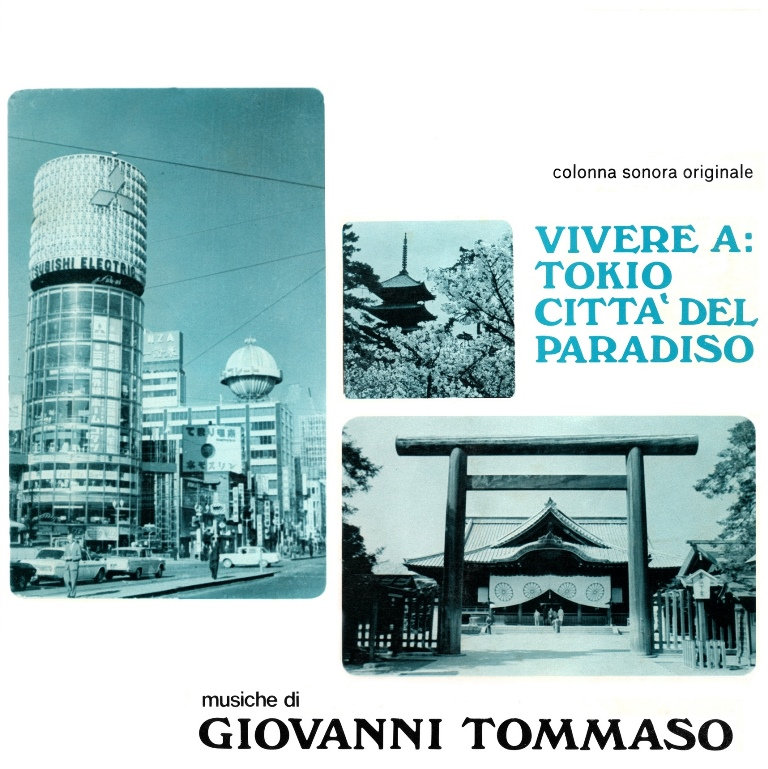
Giovanni Tommaso ‎– Vivere A: Tokio Città Del Paradiso (1972, LP, Italy)

Music composed and directed by GIOVANNI TOMMASO
Originally released in 1972 on RCA Original Cast SP 8039

Drums – Gegè Munari
Organ, Bass – Giovanni Tommaso
Musical Assistance – Carlo Arden
Organ – Antonello Vannucchi
Recording Supervisor – Giorgio Loviscek
Technician – Ubaldo Consoli


Sensational and almost impossible to find in its original edition - Original Soundtrack for the documentary composed by Perigeo's bassist Giovanni Tommaso (Living in Tokyo: City of Heaven), very active and prolific in writing Library music during the '70s. This extraordinary Score was composed to be the soundtrack for a documentary focused on Tokyo city and his inhabitants, where Giovanni Tommaso added some typical elements of melodic/harmonic Japanese music and meltied them with a kind of 'Urban' music along the line of a Jazz-Rock style he would later encode in Perigeo project. Silvano Chimenti, Antonello Vannucchi and Gegè Munari are the uncredited artists who played in this session. Outstanding oriental Prog. Rock tunes are featured here and contributed to make this lost gem also sought-after by Progressive collectors.

November 14, 2020

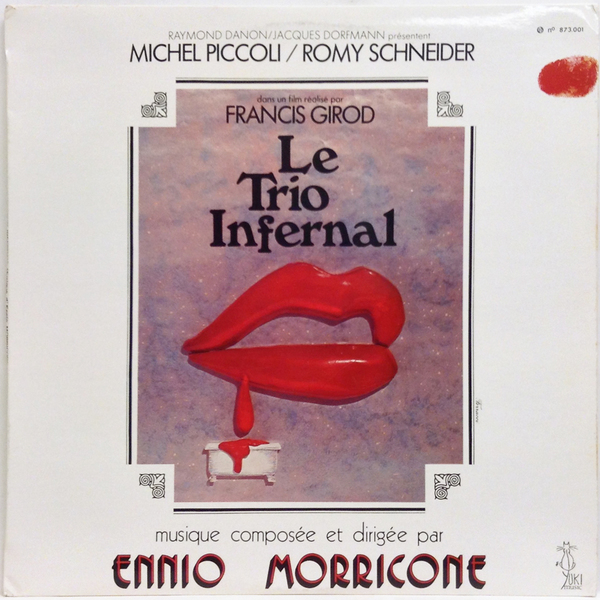
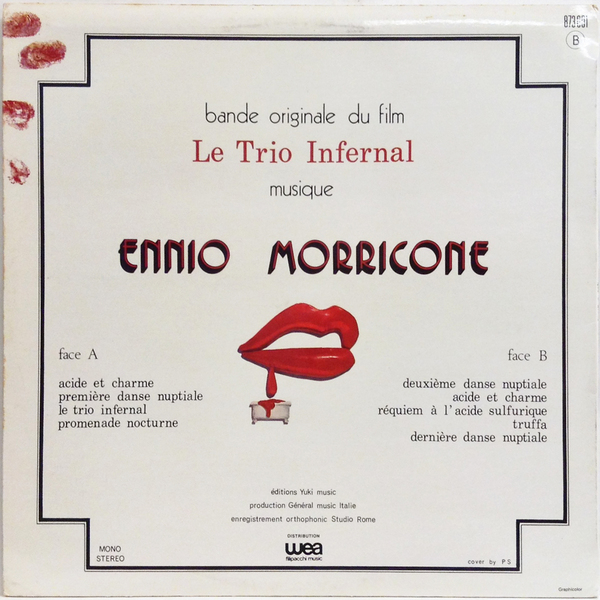
Ennio Morricone ‎– Le Trio Infernal (1974, LP, Italy)

Composer, Orchestrator, Conductor: Ennio Morricone
Voice (tracks 1,2,4,5,7): Edda Dell'Orso
Hammond Organ, Synthesizer: Giorgio Carnini

Morse Code ‎– Procréation (1976, CD, Canada)

Ethos ‎– Ardour (1976, CD, Usa)

Emmanuel Booz ‎– Dans Quel État J'erre (1979, LP, France)

Tracklist:
1. L'ôde aux Rats (16:08)
2. La Symphonie Catastrophique (9:50)
3. Armoire et Persil (8:29)

Musicians
Jean-Claude D'Agostini/ guitar
Charlie Charrieras/ bass
Maurice Mathias/ drums
Gilles Tinayre/ keyboards, synthesizer, piano
Didier Lockwood/ violin
Jean-Louis Mahjun/ alto violin
Gérard Pisani/ bass clarinet, soprano, bugle
Philippe Briche/ piano
Roger Doereux/ electronic piano
Pierre Blanchard/ violin
Jean Schultheis/ drums
Gérard Levavasseur / bass


Totally weird, and fantastic! Kind of experimental prog-rock/proto-rap/slam fusion. One of the most bizarre French rock albums ever made. (rym)

November 12, 2020

Emerald Web ‎– Dragon Wings And Wizard Tales (1979, LP, Usa)

Legendary 1979 debut LP by Miami based husband and wife synth enthusiasts on the choice format that came to represent the DIY new age electronic movement in the following decade. Emerald Web was, in fact, the wind playing electronic duo of Kat Epple and Bob Stohl. Although they’d become better known for their work scoring nature documentaries (including many collaborations with Carl Sagan), Emerald Web’s 1979 debut album was a milestone in electronic psychedelia- rooted in the prog of the mid 70s and foreshadowing much of what would come in the early 80s.
An early seminal precursor to 1980s electronic new age/minimal synth/relaxation music boom and a welcome feminine take on the genre (critically epitomised shortly after by the likes of Suzanne Ciani) Dragon Wings and Wizard Tales hear the multi-instrumentalist duo combine a broad range of modular synths (as found in similar formation to ambient krautrock records by Klaus Schulze) and the use of the Lyricon wind synth (as favoured by Swiss electronic pioneer Bruno Spoerri).
The Lyricon wind controller makes a very early recorded appearance on this album and is one of the reasons the many sounds heard here are hard to place. The line is constantly blurred between live flutes and the electronic approximations, even occasionally mimicking bird calls. It’s these sound combinations that give the songs an otherworldly quality- like hearing indigenous music from another planet.
Although some pastoral vocal songs show up here and there, eerily dreamy instrumentals make up a little more than half the record. These are certainly among the highlights and show Emerald Web’s talent for crafting soundtrack music that would come to the fore later on. “The Flight of the Raven” is a brief but gorgeous piece, summing up all that is good about this record in under three minutes. Fleeting melodies give way to dramatic clashing synths, fading away at just the right moment. “The Powerstone” recalls early King Crimson, especially the vibe of “Moonchild”. It’s on this track that Emerald Web’s knack for creating natural sounding tones and soundscapes from very electronic instruments is most evident.

Etron Fou Leloublan ‎– Les Poumons Gonflés (1982, CD, France)