Showing posts with label medieval. Show all posts

April 05, 2025

Roger Miller's Exquisite Corpse – Unfold (1994, CD, Usa)


Tracklist:
1 Entry (Mud) 0:32
2 Dance In The Poet's Eye 2:33
3 Djinn 4:32
4 Mentabolism 3:44
5 Looney Tunes 1:18
6 The Mooche 3:31
7 Nothing What 4:44
8 Game #2 1:22
9 Gargoyle 1:50
10 Owl 3:06
11 Machéte Hacker's Boogie-Woogie 3:14
12 Game #3 1:25
13 The Cheese And The Worms 2:58
14 Prelude To The Demolition Of The Teal Building 4:10
15 Dream Interpretation No. 1 (1975) 4:03
16 Exit (Bach) 0:17

Musicians:
Drums, Percussion, – Ken Winokur
Electric Violin, Violin – Judith Cohen Stanton
Guitar, Piano, Sampler, Percussion, Synthesizer – Roger Miller
Pedal Steel Guitar – Rich Gilbert (2 to 5, 11)
Performer [Shawms, Sackbut], Voice [Foreman's Voice] – Dan Stillman


April 19, 2024

Gian Castello – Taliesin (1999, CD, Italy)


Tracklist:
1. Introduzione: Kali-Yuga (L'Età Oscura) 4:06
2. Guardami - Parte Prima - 3:53
3. Tema Di Gwion 2:30
4. Le Vite Precedenti 6:35
5. La Reggia Di Tara 3:25
6. Englyn 4:32
7. Chi E Il Tuo Dio? 5:08
8. I Misteri Del Mondo 5:23
9. Guardami - Parte Seconda - 2:51
10. La Canzone Di Taliesin 4:29

Musicians:
Gian Castello/ tin whistle, concert flute, tenor flute, dulcimer, guitar, percussion, lead vocals, auto-harp
Anna Manusso/ violin, vocals
Enrico Cotella/ keyboards, percussion
Marco Canepa/ digital sampler, computer, percussion

This mutli-instrumentalist performs a pleasant mix of Celtic and Baroque prog with Italian vocals. The music features extensive flute used in a very ethnic style and delicat harpsichord chords. The vocals are in Italian, but the liner notes provide English translations. He evokes Angelo Brandauardi's most Progressive works or LE ORME in their acoustic productions.

February 28, 2021

Angelo Branduardi E Chominciamento Di Gioia – Futuro Antico I (1996, CD, Italy)

"SERIE "FUTURO ANTICO"
Negli ultimi anni si è molto parlato della crisi della musica occidentale, tanto che questa viene ormai considerata cosa scontata. Lo straordinario progresso della musica tonale ed il suo raffinato tecnicismo hanno portato ad un punto morto: ci si muove all'interno di una struttura musicalmente organizzata che non permette fughe in avanti. "Ancora tanta bella musica ci sarebbe da scrivere in do maggiore" disse Schònberg alla fine della sua vita ed è sicuramente vero, ma è proprio quel do maggiore la gabbia che ci fa apparire tutto come già sentito. Questo disco è stato fatto per allegria, da amatori, perché è vero che l'alfabetismo e l'espressione musicale più immediata, popolare, emozionale e liberatoria, sono inversamente proporzionali. Siamo partiti da un passato lontano e antimoderno là dove si suonava per la nascita e la morte, per la gioia e il dolore e per tutti i piccoli e grandi fatti della vita, in un mondo egualmente teso verso il sacro e il profano, in una profonda unità, di carne e spirito. Abbiamo ucciso i Conservatori di musica per ripartire dal mistero più lontano ed appassionante: "la musica è l'essenza del cielo e della terra" e questa essenza l'abbiamo succhiata dalla vita come fa il ragno con la sua preda. Siamo tornati selvaggi e bambini per la vostra allegria; e che questo passo indietro sia il primo di cento passi avanti. Il nostro passato sarà così, il nostro futuro: Futuro Antico." (angelobranduardi.it)

January 10, 2021

Corvus Corax ‎– Ante Casu Peccati (1989, CD, Germany)


Corvus Corax is a German band known for playing medieval music using an abundance of authentic instruments. Their name is the scientific name for the Common Raven. The band was formed in 1989 by Castus Rabensang, Win (Venustus) and Meister Selbfried ("Master Selfpeace"). The band often uses bagpipes as the solo instrument, their live performances attract attention with bizarre look of the musicians being reminiscent of ancient Greek myths: half-naked, dressed in unusual clothes, wearing different ancient-like decorations, often tattooed.

November 29, 2020

Gryphon ‎– Raindance (1975, LP, England)


Label: Transatlantic Records - TRA 302
Official DR value: DR12 (see details)

Side 1
A1 - Down The Dog  2:44
 A2 - Raindance  5:37
A3 - Mother Nature's Son  3:08
A4 - "Le Cabrioleur Est Dans Le Mouchoir" 2:14
A5 - Ormolu  1:00
A6 - Fontinental Versionr  5:36
Side 2
B1 - Wallbanger  3:33
B2 - Don't Say Go  1:48
B3 - (Ein Klein) Heldenleben  16:03

Musicians:
Bass, Flute - Malcolm Bennett 
Bassoon, Backing Vocals - Brian Gulland 
Clarinet - Richard Harvey (tracks: A4) 
Drums, Percussion - Dave Oberlé 
Grand Piano, Electric Piano [Rhodes, Rmi, Crumar], Synthesizer [Mini-moog], Organ [Copeman Hart], Mellotron, Clavinet, Glockenspiel [Keyboard Glockenspiel], Recorder, Crumhorn, Tin Whistle [Penny] - Richard Harvey  
Guitar, Backing Vocals - Graeme Taylor 
Lead Vocals - Dave Oberlé (tracks: A3, B2) 
Vocals - Brian Gulland (tracks: A6), Dave Oberlé (tracks: A6)

October 30, 2020

September 06, 2020

Angelo Branduardi ‎– Il Rovo E La Rosa (2013, CD, Italy)


Songs:
1. Baidin Fheilimi (3:36)
2. Lord Franklin (4:51)
3. Mary Hamilton (5:55)
4. Rosa Di Galilea (3:47)
5. Lord Baker (8:25)
6. Il Falegname (6:42)
7. Silkie (5:53)
8. Suite Per Arciliuto E Voce (7:36)
9. Barbrie Allen (7:05)

Musicisti:
Chitarre – Maurizio Fabrizio
Violino Barocco – Rossella Croce
Armonica – Fabio Treves
Tastiere – Leonardo Pieri
Percussioni – Davide Ragazzoni
Arciliuto – Francesca Torelli
Voce (5) – Katia Astarita
Voce, Violino – Angelo Branduardi


August 21, 2020

Acustica Medievale ‎– Acustica Medievale (1982, LP, Italy)


Lato A
Half-Moon Night (3:52)
Celle Qui M'A Demandè (1:46)
Lord Franklin (4:39)
Hoboeckentanz (1:52)
Once I Had A Sweetheart (4:30)
Quando Gli Usignoli (4:43)
Lato B
Branie De Bourgoigne (1:55)
Connemara Cradle Song (4:14)
Ballo Milanese (2:00)
Tedesca II° (1:18)
Hush, Hush (3:30)
Medley: Scioglidita-Dispari-Per Le Corde (4:35)
Twenty Second Sonnet (3:08)

Musicisti
Acoustic Guitar, Classic Guitar, Electric Guitar, Percussion, Vocals – Guido Benigni
Acoustic Guitar, Electric Guitar [Synthesized], Percussion – Massimo Santantonio
Bass, Percussion – Fabrizio Cecca
Flutes, Cromorni, Bombarde, Guitar, Vocals – Paolo Benigni
Violin – Enzo Ciotola


Gruppi britannici dediti ad ancestrali melodie folk come Amazing Blondel o Magna Charta riuscirono a varcare i confini inglesi e a farsi apprezzare moltissimo anche in Italia. Ne devono esser stati suggestionati i musicisti di "Acustica Medievale" che nasce a Roma nel 1976. Nelle sue diverse incarnazioni, che comunque vedono la presenza costante dei fratelli Paolo (voce, fiati, chitarra) e Guido Benigni (chitarra, tastiere, fiati, percussioni e voci) e di Massimo Santantonio (chitarre, mandolino), sviluppa il progetto originario di affrontare un repertorio che, partendo dal Medioevo e dal Rinascimento europei, si espande presto a comprendere materiale dell’area celtica e composizioni proprie.
Le esecuzioni spaziano dalla lettura fedele della partitura con strumentazione d’epoca, alla rilettura creativa, anche attraverso l’ausilio dell’elettronica e di strumenti elettrici al fianco di quelli acustici, con brani sia cantati che interamente strumentali. L’accostamento di una chitarra-synth pre-midi, di un vocoder o di una batteria elettronica ai flauti, ai crumorni, alla bombarda rinascimentale e bretone era certamente una mossa piuttosto temeraria e innovativa a fine anni ’70 / primi ‘80. È però proprio tale cifra espressiva a fruttare al gruppo una riconoscibilità comprovata da numerosissimi concerti sul suolo nazionale, sia in ambiti “colti” che non, e perfino da diverse apparizioni radiotelevisive, spesso “live” (inclusa la trasmissione “DOC” di Renzo Arbore). È anche l’epoca del revival europeo della musica celtica, guidato da musicisti quali Alan Stivell ed i Chieftains. Con questi ultimi Acustica Medievale è in cartellone nel 1979 al Festival di Musica Celtica organizzato dal Folkstudio a Villa Pamphili a Roma, dove per una settimana viene richiamato ogni sera un pubblico che spesso supera le diecimila unità. Per oltre un decennio Acustica Medievale è di casa al Folkstudio di Roma, dove l’apprezzamento da parte del patron Giancarlo Cesaroni si traduce nell’opportunità di incidere un LP (“Acustica Medievale”, 1982) per l’etichetta omonima, prodotto destinato a ricevere ottime recensioni sulla stampa specializzata e non.

April 25, 2020

Księżyc - Księżyc + Nów (1996/93, LP+Ep, Poland)


Tracklist:
A1. Historyjka - 0:41
A2. Verlaine 1 - 2:00
A3. Klepana - 2:08
A4. Klawesynowa - 2:55
A5. Chodź - 1:18
A6. Mijana - 6:00
A7. Zakopana - 4:18
B1. Lalka - 2:53
B2. Śmieszki - 1:51
B3. MM - 2:41
B4. Dychana - 1:52
B5. Ile Ma Lat? - 3:33
B6. Verlaine 2 - 2:41
B7. Historyjka - 2:19

Musicians:
Accordion, Grand Piano, Synthesizer – Lechosław Polak
Clarinet, Alto Saxophone, Grand Piano, Keyboards – Robert Niziński
Synthesizer [Korg Monopoly] – Wojcek Czern (tracks: A4, B5, B6)
Vocals – Agata Harz
Vocals, Grand Piano – Katarzyna Smoluk

Tracklist:
A1. Chodź - 1:38
A2. Zakopana - 5:00
B1. Gdzieś Ty Byla - 5:36

Musicians:
Clarinet – Robert Niziński
Performer, Tape, Songwriter – Remigiusz Hanaj
Performer, Vocals – Agata Harz, Kasia Smoluk

Note
Recorded live on June 22, 1992 at The Church Of St Vitus, Wrocław, Poland.


“Avant-folk”, “ethno-psychedelic minimal”, and even “post-Komeda-jazz” – there are just a few examples of how was described the stylistics of Księżyc (The Moon) – a music group founded in the early 90s of the last century and reactivated in 2014.

Księżyc (Moon) was a project from Poland active in the 1990s. Members included Agata Harz (vocals), Katarzyna Smoluk (vocals, piano), Robert Niziński (wind instruments, keyboards), Lechosław Polak (accordion, keyboards, synthesizers), and Remigiusz Mazur-Hanaj (lyrics, tapes). The spirit of Księżyc captures early and late music with a medieval sound, rooted in Slavic tradition combined with elements of minimalism and vocal experiments of the 20th century. The alchemy of these constituent parts results in a breathtaking original music, both delicate and sinister. The surreal, fairy-tale-inspired lyrics add to the inherent beauty, sadness, and madness within. Originally released on cassette and 10" vinyl by OBUH Records in 1996, the group's defining statement has now been remastered by Piotr Nykiel at Nykiel Audio and cut on 12", allowing for vastly improved sound quality.

Unique ethereal avant ritual folk with female vocals, not to be missed by anyone interested in music of strange & exquisite beauty.Relesed by Poland's Obuh label.
Michael J. Salo wrote in 2005:
Just continuing the description above. I can hardly contain my enthusiasm for this release. I love this music.The best I can try to explain Ksiezyc ("The Moon"), is some blend of the romantic-acoustic-ballad Prikosnovenie school groups such as Fleur, together with the psychedelic experimentalism of the great Polish acts Atman & Magic Carpathians. I'm also getting a Jack or Jive vibe out of this (a Polish Jack or Jive?) Anyone interested in any of the above references should aquire this album without hestitation.The female vocals are higher quality than 90% of music recorded today, and meanwhile there is more careful attention to instrumental sonics than you could ever expect in vocally-oriented music.Available information in English on this group is scant, but this new release is apparently a collection of all their recorded music, which dates back to the early 90's. Who knew?It's tempting to declare, "ahead of their time," but that wouldn't be quite right. Instead this band is completely removed from time. This is timeless.A hand numbered limited edition item, in appropriately unique & beautiful handmade packaging. Talk about a gem. (mutantsounds)

April 16, 2020

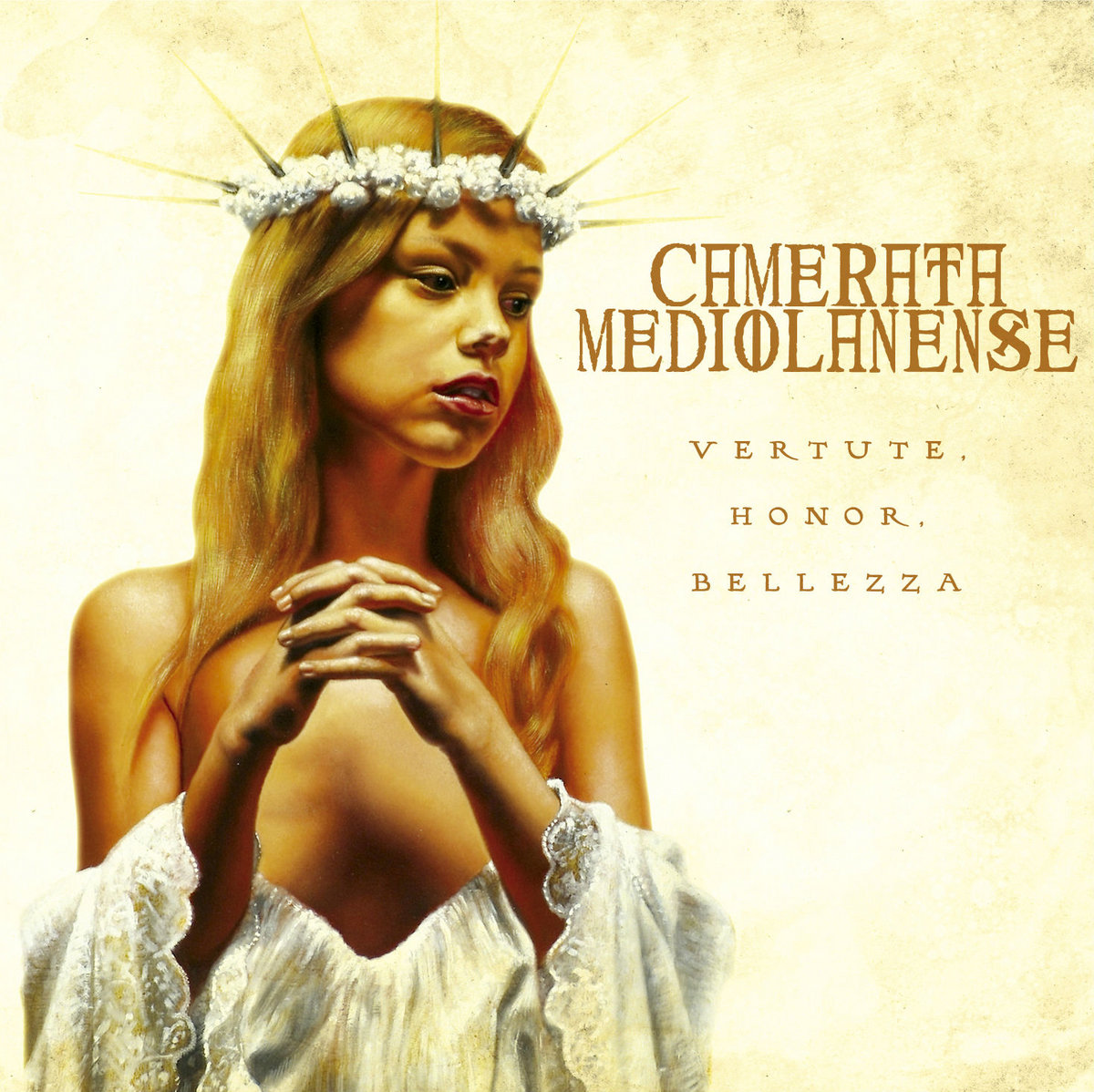
Camerata Mediolanense ‎– Vertute, Honor, Bellezza (2013, CD, Italy)


Tracklist:
01. Voi Ch'ascoltate - 5:00
02. Dolci Ire - 4:07
03. Canzone Allitalia - 4:38
04. 99 Altri Perfecti - 4:05
05. Fragmentum XXXV - 1:39
06. Solo Et Pensoso - 5:34
07. Tremo Et Taccio - 5:26
08. Vago Augelletto - 5:23
09. Vergine Bella - 4:48
10. Lo Gran Desire - 3:20
11. O Mia Stella - 3:57
12. Quest'anima Gentil - 4:25

Musicians:
Backing Vocals, Chorus – Chiara Rolando, Daniela Bedeski
Bass – Edi Zuliani
Cello – Annamaria Cristian
Chorus – Daniela Ciannarella, Desiree Corapi, Elisa Santoro, Giancarlo Vighi, Paola Favalessa, Teresa Signorino, Vittorio Dante Ceragioli, Viviana Zordan
Harp – Giovanna Di Lecce
Lead Vocals – Daniela Bedeski (tracks: 1, 2, 5, 8, 9), Desiree Corapi (tracks: 8, 10), Elisa Santoro (tracks: 10), Matteo Benedini (tracks: 12), Vittorio Dante Ceragioli (tracks: 8)
Lyrics By [Based On Poems] – Francesco Petrarca
Performer – Elena Previdi, Manuel Aroldi, Marco Colombo, 3Vor


Ever since its foundation in 1994, Italian collective Camerata Mediolanense merges Wave and Post Punk with the musical spirit of the Renaissance and Baroque periods, not shying away from experimentation. Although they have been received mainly within the neoclassical and neofolk spheres, professional composer and musicologist Elena Previdi and her entourage cover a wide area, ranging from traditional songs across archaic rhythmic parts to electronic elements, all of which make it hard to categorize the three studio albums, multiple singles, and EPs Camerata Mediolanense has issued so far.

After five years in the making, Camerata Mediolanense's fourth album "Vertute, Honor, Bellezza" (English: "Virtue, Honour, Beauty") is finished now. With the new album the band continues to proceed on its path, mixing archaic, traditional and tribalistic music with experimental and electronic sounds.
The album is the centrepiece of Camerata Mediolanense's "Petrarca project," which is conceptually based on the poetry of 14th century scholar, poet, and humanist Francesco Petrarca, one of the fathers of Italian language and literature. The project was initiated by the CD single "99 Altri Perfecti" (2011) and is closed by the CD single "Vergine Bella," which are both included in the art-book edition of "Vertute, Honor, Bellezza."

October 13, 2018

September 15, 2018

Dominique Guiot ‎– La Dame À La Licorne (1983, LP, France)


LP - Auvidis ‎– AV 4168

Side A
A1. La Dame À La Licorne (2:10)
A2. Bouffon Du Roi (3:30)
A3. Le Chevalier Errant (4:30)
A4. Le Chevalier Nous Revient (4:30)
A5. Le Philtre D'Amour (2:50)
A6. Les Cavaliers (2:15)
A7. Menestrel (1:35)
Side B
B1. Tourbillon (4:10)
B2. Colin-Maillard (3:15)
B3. Le Sabot De Pégase (3:10)
B4. Farfadet (6:15)

Musicians:
Alto Saxophone – Marc Richard
Drums – Kirt Rust
Flute – François Proust, Jean Cohen-Solal
Guitar, Keyboards – Dominique Guiot
Percussion – Jean-Michel Bertrand
Piano – Armand Frydman
Recorder – Robin Troman
Saxophone – Philippe Giselman
Synthesizer – Armand Frydman
Trumpet – Dominique Gable

Very interesting interpretation of French middle age folk music. With a band composed of Jean Cohen-Solal and Armand Frydman amongst others. With the killer prog folk track "Farfadet", and "Le Sabot De Pegase".

March 11, 2018

Angelo Branduardi ‎– Gulliver, La Luna E Altri Disegni (1980, LP, Italy)


Songs
1. La luna (2:49)
2. Tanti Anni Fa (5:06) 
3. Donna Mia (2:50)
4. Gli Alberi Sono Alti (4:09) 
5. Notturno (4:51)
6. Gulliver (4:11)
7. Rifluisce Il Fiume (4:29)
8. Confessioni di un malandrino (3:33)
9. Primavera (3:26)
10. La Danza (4:09)

Musicians
Angelo Branduardi / violin, classical guitar, flute, percussion
Maurizio Fabrizio / electric and acoustic guitars, mandolin, percussion, quatro
Bruno De Filippi / bouzouki, quatro, guitar, sitar, banjo, harmonica
Gigi Cappellotto / electric bass
Andy Surdi / drums
Mike Logan / keyboards

February 23, 2018

Radio Noisz Ensemble ‎– Yniverze (1982, LP, Germany)

The Radio Noisz Ensemble from the Weinheim an der Bergstraße area was the successor group of Emma Myldenberger, who had played folk with medieval touch. Instead, the music with an oboe as the lead instrument was now more complex and oriental, sometimes almost meditative, entirely instrumental, and was partly evocative of Between, Tri Atma, and the Third Ear Band.
By the time of their LP "Yniverze" they had become really complex, involving mantric styled rhythms, along with extensive use of Turkish and Middle-Eastern themes.

January 13, 2018

Цукор Біла Смерть [Cukor Bila Smert'] ‎– Selo (1993, Cassette, Ukraine)

The material was recorded in May'93 in Warsaw. Comparing to "drastic autopsy of mentality" climates present in previous record "Manirna Muzyka", this music is intended to be rather delicate, muffled and reflective. It is more experimental with strong baroque ornaments.

January 06, 2018

Angelo Branduardi - La Luna (1975, LP, Italy)

Lato A
La luna – 2:48
Tanti anni fa – 2:49
Donna mia – 3:32
Gli alberi sono alti – 4:08
Notturno – 4:51
Lato B
Rifluisce il fiume – 4:29
Confessioni di un malandrino – 5:06
Primavera – 3:26
La danza – 4:08

Musicisti
Angelo Branduardi - violino, chitarra classica, flauto dolce, percussioni, voce, cori
Maurizio Fabrizio - chitarra acustica, chitarra elettrica, mandolino, cuatro, cori, percussioni
Michael Logan - tastiera
Gigi Cappellotto - basso
Andy Surdi - batteria
Bruno De Filippi - bouzouki, cuatro, chitarrino, sitar, banjo, armonica


La luna è il secondo album di Angelo Branduardi, del 1975. Fu ristampato nel 1980 con l'aggiunta di un nuovo brano, con nuovi mixaggi e con il titolo modificato in Gulliver, la luna e altri disegni. Del disco originale esiste la sola versione su LP. Della versione originale si possono trovare tre tirature, due datate al 1975 e una al 1976, identificabili per la data apposta dalla tipografia sul retro della copertina; a parte il cambio di data l'lp rimane identico, con copertina pesante e laminata. Una successiva edizione, priva di data sul retro, è stampata su cartoncino leggero non laminato ed è considerata come ristampa.
Arrangiato da Maurizio Fabrizio, il secondo tentativo riesce a evocare il mondo musicale che Branduardi ha in mente. La Luna, Tanti Anni Fa, Notturno, e la notevole Confessioni Di Un Malandrino presa a prestito dal poeta Esenin sono i momenti migliori di un disco affascinante e ben equilibrato tra composizioni arrangiate con semplicità acustica e “pieni” orchestrali che Branduardi riesce a tenere sotto controllo con una sola apparentemente fragile timbrica vocale.

November 18, 2017

Angelo Branduardi - Alla Fiera Dell'Est (1976, CD, Italy)

Songs:
1 - Alla fiera dell'est (5:22)
2 - La favola degli Aironi (3:43)
3 - Il vecchio e la farfalla (2:54)
4 - Canzone per Sarah (4:19)
5 - La serie dei numeri (4:28)
6 - Il dono del cervo (3:11)
7 - Il Funerale (8:06)
8 - L'uomo e la nuvola (3:44)
9 - Sotto il tiglio (2:52)
10 - Canzone del rimpianto (3:00)

Musicians:
Tiziana Botticini: Harp
Angelo Branduardi: Guitar, Violin, guitar Ottavino, Luth
Gigi Cappellotto: Electric bass
Bruno De Filippi: Buzuki, Cuica, Banjo, Sitar, Armonica bass
Maurizio Fabrizio: guitar, Luth
Mario Lamberti: Percussions
Gianni Nocenzi: Clarinet, Piano
Andy Surdi: Drums


Branduardi's most successful period started with this album which is really an encounter with medieval folklore arranged and performed with a strong classical taste on acoustic instruments ( including strings and brass ) and no "prog" or "rock"-music at all, so beware. 
The beautiful voice of Angelo can sound joyous as well as sad and languishing, as the music is a varied offer of uplifting celebrations and reflective ballads. Sometimes ( with the title track, "Il vecchio e la farfalla", "La serie dei numeri", "Il dono del cervo" and "sotto il tiglio" ) you almost feel like being a guest at a lively feast held on an old king's castle, other times you can imagine yourself a princess sitting in the tower with a minstrel standing underneath the window, trying to enchant you with soft melodies and sensitive stories about life and death ( "La favola degli aironi", "Il Funerale" ) and Lullabies ( "Canzone per Sarah" ), as if nature itself would weave the gentle sound of an orchestra around strange lovestories like the one about a man and a cloud ( "L'uomo e la nuvola" ). It's music to fall in love to ( and to fall in love with ) and meant to entertain in a rather contemporary way - but it's so charming and full of lovely little details that it ought to succeed.
Imagine a bunch of grown up children making noise for children of any age who are willing to listen and think about the stories they can hear - and then you get a glimpse of what Branduardi and his versatile ensemble were up to. Talking about himself in later years, the artist said he was "a fivehundred year old child"... well, that might be a fitting description ! This music is out to make you feel good and comfort you even when it's sad, it's a well of empathy and harmony in a world that more than often is giving you the opposite. Branduardi was just about finding his formula, and while there were better albums before ( "La Luna" ) and afterwards ( "La Pulce d'Acqua", "Canta Yeats" ) it still remains a classic in its own right and a five-star for fans. It established Branduardi as an artist who in his unique way held on to traditional values and didn't care about trends and fashion but nonetheless found the wider audience he deserved. A special mention must go his great guitar-duellist and arranger Maurizio Fabrizio - there could have been no better partner and it was always a pleasure when the both of them got together.
4 stars for the open-minded who are willing to lend their ears to something else than "prog" and five for lovers of folk and medieval music.