April 29, 2021

Claudio Rocchi – Volo Magico N.1 (1971, LP, Italy)


Tracklist:
A Volo Magico N.1 - 18:27
B1 La Realtà Non Esiste - 2:28
B2 Giusto Amore - 11:05
B3 Tutto Quello Che Hai Da Dire - 4:04

Musicians:
Bass – Eno Bruce
Drums – Lorenzo Vassallo
Guitar, Acoustic Guitar – Alberto Camerini, Ricky Belloni
Lead Vocals, Guitar, Electronics – Claudio Rocchi
Piano, Keyboards – Eugenio Pezza
Vocals – Donatella Bardi


A perfect combination of experiment, progressive music, acoustic foundations with tape collage, singer-songwriting, with lots of inspiration and invention with a good materialisation of it with clear structures, and interesting contemporary ideas. Trippy streched improvisation like tracks, as if the whole album are a kind of (acoustic) outro-freak outs, as stoned composition (still song based) trips. Volo magico n.1, is usually considered as his best effort, in much the same style as Alan Sorrenti's Aria with a side-long title track and softer tracks on the other side. The 18 minute long title track starts with a soft introduction and goes on with hypnotic move based on the guitars of Alberto Camerini and Ricky Belloni (from Nuova Idea and later New Trolls).

Claudio Rocchi – Viaggio (1970, LP, Italy)

Tracklist:
A1 Oeuvres - 5:36
A2 La Tua Prima Luna - 3:37
A3 Non È Vero - 2:37
A4 Ogni Uomo - 4:52
A5 Gesù Cristo (Tu Con Le Mani) - 5:55
A6  Ma Qui - 1:11
B1 I Cavalli - 1:58
B2 Acqua - 5:22
B3 8.1.1951 - 4:52
B4 Questo Mattino 2:03
B5 Viaggio - 7:28

Musicians:
Violin, Flute, Congas – Mauro Pagani
Vocals, Guitar, Bongos, Piano – Claudio Rocchi
Vocals - Roberta Rossi (2) Annie Lerner (5)


Claudio Rocchi was the original bass guitarist of Stormy Six, and played on their first album 'Le idee di oggi per la musica di domani', leaving the band soon after the album release for a solo career that started in 1970 with the first album 'Viaggio', mainly acoustic and with good flute, with a large use of reverb, feedback and sound experiments.

April 27, 2021

Re-Up#13

Julverne ‎– À Neuf (1980, CD, Belgium) here
Gallary ‎– Gallary (1979, LP, Germany) here
André Popp ‎– Le Coeur En Fête (1972, LP, France) here
Yuri Morozov - Inexplicable (1978, USSR) here

April 26, 2021

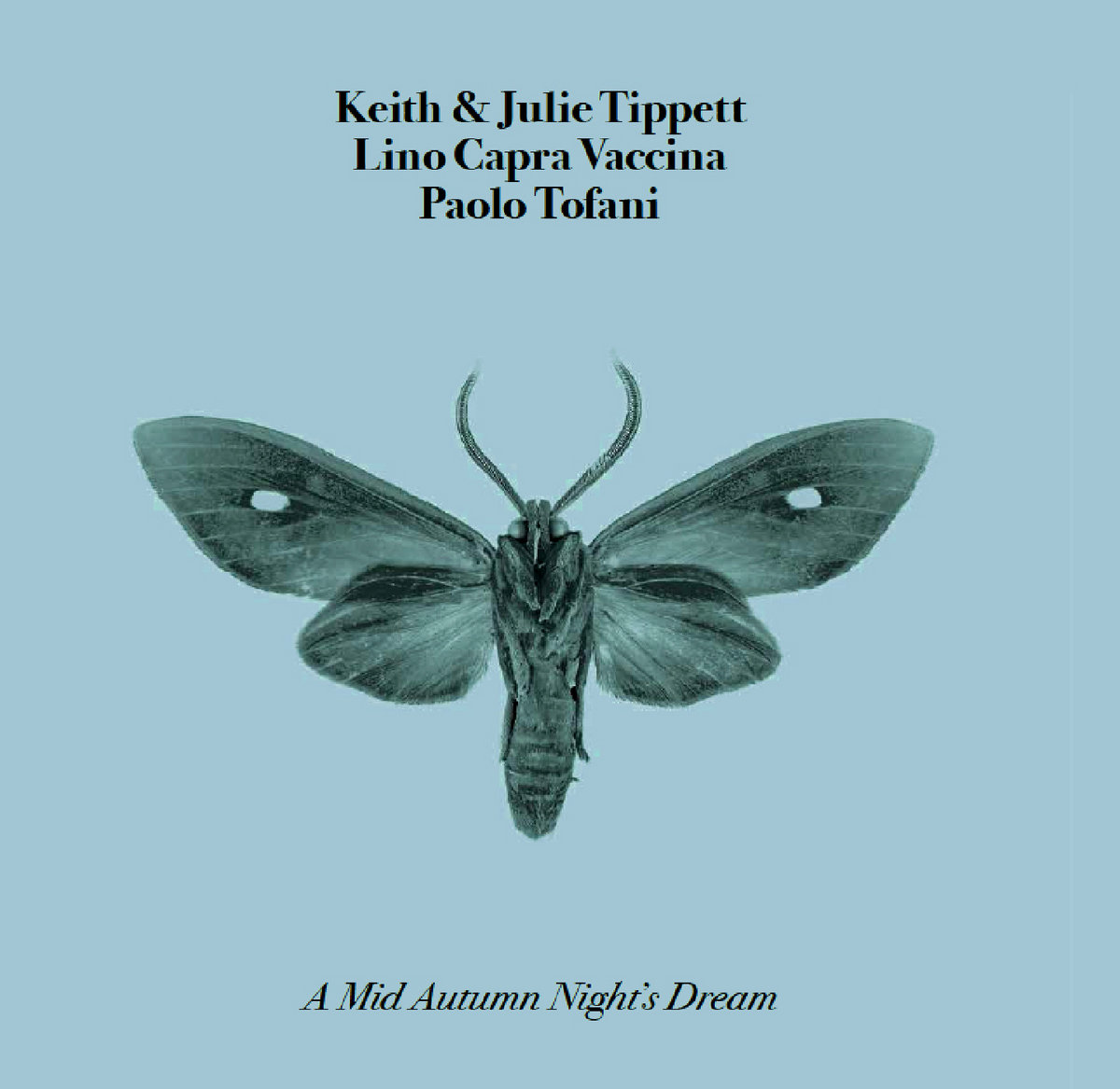
Keith & Julie Tippett, Lino Capra Vaccina, Paolo Tofani – A Mid Autumn's Night Dream (2019, LP, Italy)


Tracklist:
A Part 1 (23:24)
B Part 2 (23:14)

Musicians:
Piano, Musical Box, Wood Block, Idiophone, Maracas – Keith Tippett
Veena, Santoor, Electronics, Performer – Paolo Tofani
Vibraphone, Cymbals, Percussions, Gongs, Tam-tam, Timpani, Chimes, Bells – Lino Capra Vaccina
Voice, Bells, Thumb Piano, Drum, Xylophone – Julie Tippetts

Recorded Conservatorio Nicolini in Piacenza on October 1st, 2016

A Mid Autumn Night’s Dream faithfully report a one shot concert that took place at Conservatorio Nicolini in Piacenza on October 1st, 2016. The four giants of new music never played together before. As the lights turned off something magic started. A spontaneous interplay, an amazingflowing of notes. The subject was the Night, its mystic flavours. Paolo Tofani, now a hindi monk, is a living legend in Italian avantgarde music having been the driving force of the band Area in the seventies. He worked and recorded with many musicians including John Cage, Alvin Curran, Steve Lacy just to mention a few. His last album, Real Essence, an acoustig solo, have impressed the late Greg Lake whoeventually wrote the liner notes. Lino Capra Vaccina provided the visionary sound of the seminal italian ensemble Aktuala then formed with Franco Battiato and Juri Camisasca the legendary Telaio Magnetico, then worked with Battiato and eventually played percussion in La Scala Orchestra with Claudio Abbado. In Italy he is a true legend and a most respected muscian. His first solo album, Antico Adagio along with his last one Metafisiche del Suono, are considered amongst the very best avantgarde albums ever. Keith Tippett is another living legend in british jazz music: band leader, composer, visionary pianist. With an uncompromising career full of outstanding gems. A larger audience knows him as a member of King Crimson or theleader of Centipede. His skills goes from contemporary jazz to larger compositions for orchestra and classical musicas well. One of his latest piano solo album, Mujician IV live in Piacenza, have been critically acclaimed all over the world. Julie Tippetts lent her fantastic voice to various situations, many times side by side with her husband Keith. The team called one of their duo album Couple in Spirit, as they are in life and art. Julie is a fantastic musician who added a magic touch, a siren call to this masterpiece.

April 25, 2021

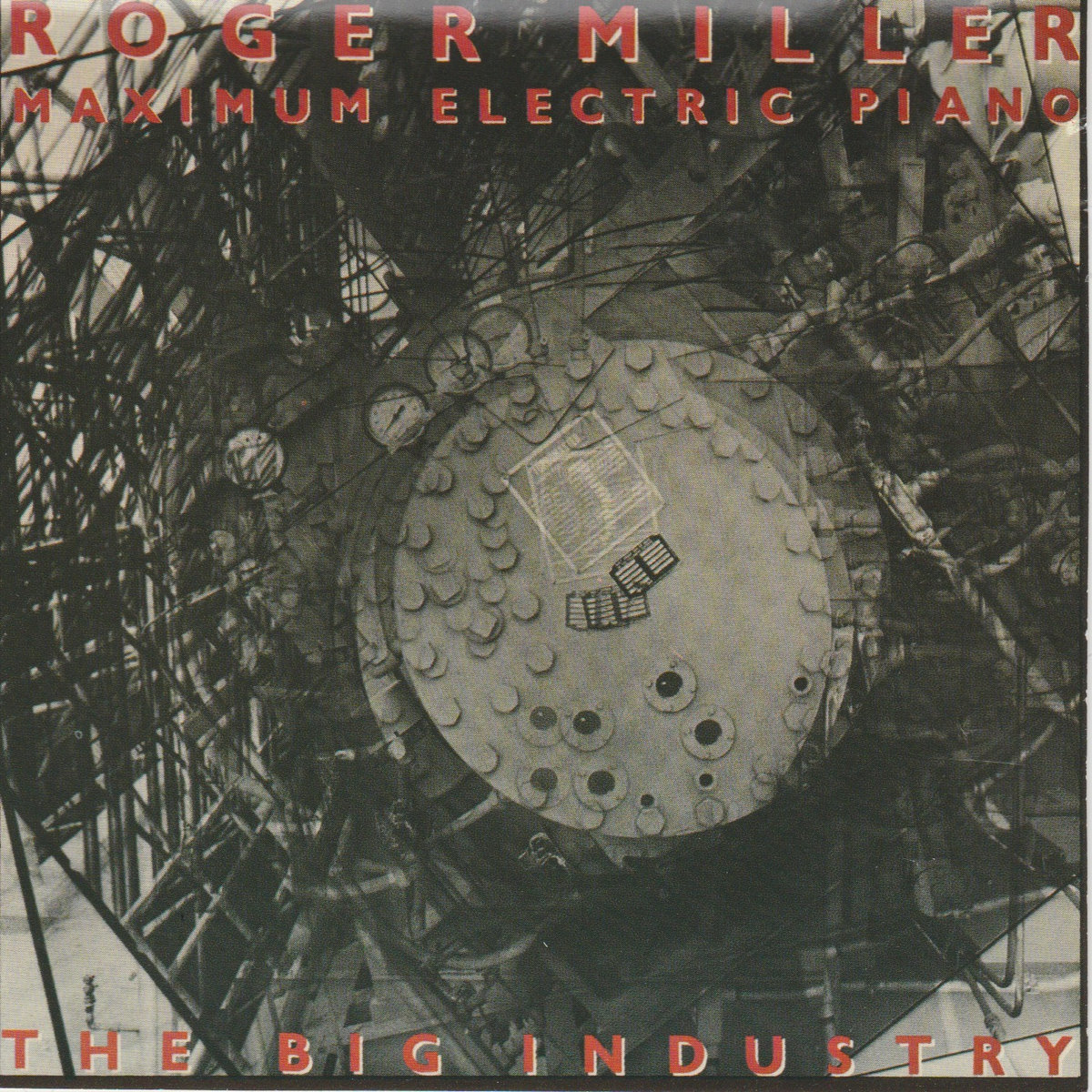
Roger Miller, Maximum Electric Piano – The Big Industry (1987, LP, Usa)


Tracklist:
A1 Portrait Of A Mechanical Dog - 3:01
A2 Boil Away - 2:59
A3 Hammers - 4:04
A4 Upon This Boat In This Sea - 3:00
A5 The Age Of Reason - 4:49
B1 Groping Hands - 4:38
B2 Manic Depression - 3:29
B3 The Big Industry - 7:19
B4 We Don't Know Why - 3:29

Musicians:
Sampler [Sampled Percussion Set: Oil Tank, Furnace, Egg Beater, Lawn Mower, Hubcap, Metal Sheet, Childeren's Bells, Helium Tank, Marching Snare Drum With Marbles In It,occasional Linndrum Sounds] – Russ Smith
Saxophone, Clarinet – Steve Adams
Percussion [Hammers On Pipes, Girders, Etc.], Vocals [Foreman's Vocals] – Russ Smith
Piano, Percussion [Sampled And Realtime Percussion], Voice – Roger Miller
Viola – Melissa Howe

Roger Miller's career is one of the most adventurous in rock history. He began with Sproton Layer, a Boston band who played psychedelic, Pink-Floyd-like music (and which had their first album With Magnetic Fields Disrupted published by New Alliance just in 1992). Miller became then the guitarist of Mission of Burma, the legendary punk band also from Boston. Afterwards, together with Erik Lindgren, Miller founded the Birdsongs of the Mesozoic. As that experience also came to an end, Miller had revealed himself to be a virtuoso of the piano, which was soon to be his only instrument.
...
Miller's classical ambitions are more evident in The Big Industry (Ace Of Hearts, 1987), a maximum electric piano album (where maximum stands for prepared). It contains blurring, industrial mini-symphonies (above all The Age Of Reason and the title-track) and surreal, crazy lieder (Portrait Of A Mechanical Dog). The ballad Groping Hands, based on a weak metallurgic poli-rhythm, is emblematic. (Scaruffi)

Masaru Imada Trio +2 – Green Caterpillar (1975, LP, Japan)

Tracklist:
A1 A Green Caterpillar - 11:24
A2 Straight Flash - 10:27
B1 Blue Impulse - 10:28
B2 Spanish Flower - 11:15

Musicians:
Bass – Isoo Fukui
Congas, Percussion – Yuji Imamura
Drums – Tetsujiro Obara
Guitar – Kazumi Watanabe
Piano – Masaru Imada


Japanese jazz is sadly one of best-kept secret. But, it would be stupid to not discover "Green Caterpillar" by Masaru Imada trio + 2. Led by Masaru Imada and his Fender Rhodes, the record opens with " A Green Caterpillar", a 11 minutes piece whose the groove is somewhat reminiscent of Marc Moulin and his Placebo band. "A Straight Flash" continues along this line, while on "Blue Impulse" and "Spanish Flower" Masaru Imada uses the piano in a much more modal style.

April 24, 2021

Hopper/Dean/Tippett/Gallivan ‎– Cruel But Fair (1977, LP, England)

Tracklist:
A1 Seven Drones - 8:30
A2 Jannakota - 4:36
A3 Echoes - 8:43
B1 Square Enough Fire - 9:23
B2 Rocky Recluse - 2:24
B3 Bjorn Free - 2:18
B4 Soul Fate - 5:38

Musicians:
Alto Saxophone, Saxello – Elton Dean
Bass – Hugh Hopper
Drums, Percussion, Synthesizer – Joe Gallivan
Piano – Keith Tippett


Alto saxophonist Elton Dean and bassist Hugh Hopper established their reputations with the groundbreaking jazz-rock band Soft Machine in the '70s and have continued to be strong forces in the British free-jazz scene. On this excel1ent 1995 release, they team up with pianist Keith Tippett and drummer Joe Gallivan to create a wide-ranging program of bristling, exploratory jazz and innovative electronic music. Gallivan plays synthesizer in addition to his propulsive, pulse-oriented drums, and on several cuts ("Jannakota" and "Rocky Recluse") the music drifts into beguiling electronic soundscapes. These serve as interludes for the more energetic and fiery pieces featuring Dean's singular sax and Tippett's dense, multilayered piano. Dean's distinctive alto and the seldom-played saxello both project a plaintive, vocalized sound, equally adaptable to the frenzy of "Seven Drones" or the calm of "Echoes." This ability to shift emotional gears, shared by the group as a whole, results in a collective music that is both spontaneous and cohesive.

Andrea Centazzo – Ictus (1974, LP, Italy)


Tracklist:
A1 First And Last Freedom - 3:43
A2 In The Swamp - 10:23
A3 Anthropomorphic Prelude - 4:12
A4 Social Capillary Hypnosis Part I - 1:10
B1 Ode To Nazim Hikmet - 5:15
B2 Via Casette Nr 0 - 4:30
B3 Press-Paper Mirror - 2:00
B4 Who Remembers The Lestans Cement-Works? - 4:05
B5 Social Capillary Hypnosis Part II - 2:05

Musicians:
Drums, Percussions, Flute, Synthesizer, Vocals – Andrea Centazzo
Double Bass, Electric Bass – Franco Feruglio
Keyboards – Armando Battiston


Before his magnificent experiments with electronic music on Elektrictus (previously reissued on Wah Wah), Andrea Centazzo was already an accomplished musician who had issued his recorded works on the PDU and RCA labels. His first release was Ictus, a free-form avantgarde jazz oddessey on which he already started to experiment with electronic generated sounds. Ictus was a band formed by Centazzo, Armando Battiston and Franco Feruglio, although back in the day the sleeve of the PDU release credited the work only to Centazzo, and as if Ictus was simply the title of the album. This was a big mistake that we have been asked to correct in our reissue. A brave drummer and percussionist, on this album Centazzo also played flute, synths and sang. He was joined on some tracks by Franco Feruglio on bass and double bass and Armando Battiston on keyboards. It has been compared to Soft Machine's Third or Wolfgang Dauner's Et Cetera.

April 18, 2021

Sales De Baño – Geometría Del Vínculo (2019, LP, Argentina)

Tracklist:
1. Asu (04:06)
2. Geometría del vínculo Parte I (06:01)
3. Confiamos en el veneno Parte I (06:38)
4. Primer temblor Parte I (03:29)
5. Geometría del vínculo Parte II (06:02)
6. Primer temblor Parte II (03:16)
7. Confiamos en el veneno Parte II (04:38)
8. Mono (04:53)

Musicians:
Mariano Cepeda / guitar
Andrés Marino / piano, keyboards, electronics
Agustín Zuanigh / trumpet
Camilo Ángeles / flutes
Carlos Quebrada / bass, composer
Federico Isasti / drums


Based in the city of Buenos Aires, Argentina, Sales de Baño is a group that brings together musicians of different nationalities. Led by Colombian composer and bassist Carlos Quebrada, their sound explorations have led them to expand the languages of jazz, and incorporate elements of experimental rock, contemporary music and free improvisation. "Geometría del vínculo" [Geometry of the bond], Sales de Baño’s third album, can be understood as an avant-garde jazz album which is also connected with the spirit of Rock in Opposition. The ostinati converse with free forms, in sequences that can lead to attacks of noisy abstraction, which spring from both rock and free jazz, then go back and build complex sonic architectures where the guitar and the trumpet are featured as solo instruments.
"Geometría del vínculo" consolidates Sales de Baño as one of the most innovative groups of the Argentinean experimental scene, which has brought to international attention other notable groups, and of similar concerns, such as Nicotina es Primavera or El devenir del Río. Sales de Baño is made up of Carlos Quebrada (bass and composition), Federico Isasti (drums), Andrés Marino (piano, keyboards and electronics), Camilo Ángeles (flutes), Mariano Cepeda (electric guitar) and Agustín Zuanigh (trumpet).

Demi Semi Quaver – Demi Semi Quaver (1994, CD, Japan)


Songs:
1. Recreation (4:41)
2. Love Maniac (3:31)
3.Fundamentarhythm (5:21)
4. Black Milk (5:24)
5. P+P (0:21)
6. A*Merika (12:08)
7. Diva Operation Sex Nox (6:25)
8. 第2魔術 Second Magic (3:54)
9. S+P (0:11)
10. ロックの隠れ家 Hideout Of Rock (4:13)
11. ~S~mash Room (6:27)
12. The Door Was Always Part Of The Wall And ~Key~ (2:15)

Musicians:
Bass – Hidenori Yokoyama
Drums – Koichiro Naka
Guest, Violin – Yuji Katsui (tracce: 3, 5)
Guitar, Kazoo – Toru Terashit*
Keyboards, Sampler – Genya Kuwajima
Percussion, Effects [Metals], Backing Vocals – Steve Eto
Vocals, Accordion, Synthesizer [YC-30], Piano, Backing Vocals – Emi Eleonola
Written-By – Demi Semi Quaver (tracce: 1 to 4, 6 to 12), Emi Eleonola (tracce: 5), Hoppy Kamiyama (tracce: 2, 6, 8, 9, 11, 12), Yuji Katsui (tracce: 5)


DEMI SEMI QUAVER got started as an experimental-avantgarde rock outfit featuring Emi ELEONOLA, a female vocalist of marked personality. Dressed in a bondage suit, Emi utters a weird and mysterious lyrics called 'Eleonola Language' upon their songs, that can charm the audience into Demi Semi world. In 1995, they appeared on Japanese underground rock scene with their eponymous debut album full of experimentalism, aestheticism, avantgardism, and individualism. A magnificent lineup - Yuji KATSUI (violin), Steve ETOH (percussion), TELLASIT (guitar), Hidenori YOKOYAMA (bass), and Koichiro NAKA (drums) - supports her, and they leaped into Japanese Underground Stardom.
Through many active gigs, DEMI SEMI QUAVER made their major debut with the third album '3' in 1996. They often appears on stage despite of getting less active than before, since each member can get more renowned currently as a session musician or a member of another progressive rock project (Emi has got a versatile artist e.g. actress, model, or fashion designer).

April 17, 2021

Atilla Engin Group Featuring Niels-Henning Ørsted Pedersen & Uffe Markussen – Melo Perquana (1988, LP, Turkey/Denmark)

Tracklist:
A1 Melo Perquana  7:12
A2 What Is Truth  9:05
A3 Cumbe De Cumbe  6:01
B1 Independent Fantasy  9:37
B2 Indian Affair  5:58
B3 Arap Ati  5:29

Musicians:
Bass - Niels-Henning Ørsted Pedersen
Saxophone [Tenor, Soprano] - Uffe Markussen
Vocals - Ane Ramløse
Vibraphone, Timbales, Tambourine, African Cimbe [Hand Drum], Percussion, Synth, Effects - Morten Grønvad
Roland Drum Machine, Vocal, Bongoes, Timbales, Synth, Santhura of India, Kalimba, African Drum [Talking Drum], Percussion, Mouth Percussion, Effects, Producer, Cover Idea - Atilla Engin

Recorded At Karma Studios, Oct. 3, 4 & 5 + Nov. 12 1987, Denmark

April 15, 2021

Re-Up#12

Fabio Frizzi ‎– Lucio Fulci's Requiem In Blood (1996, CD, Italy) here
Folk Magic Band ‎– Jazz Al Folkstudio (1976, LP, Italy) here
A. Alessandroni ‎– Angoscia (1975, LP, Italy) here
Buenos Aires Jazz Fusion ‎– Buenos Aires Jazz Fusion Volumen 1 (1982, LP, Argentina) here

April 12, 2021

Marco Minnemann – Broken Orange (2002, CD, Germany)


Tracklist:
1. Kate (4:45)
2. Crack In The Muscle (5:43)
3. Friday Midi (3:57)
4. Diddles (5:17)
5. The Beauty Of One Note (3:10)
6. Bread-Fish-Dance (3:36)
7. Rim (5:48)
8. Broken Orange (3:43)
9. One Little Moment (4:49)
10. Nein-Too (7:36)
11. Mr. Kempinski (4:50)
12. Waiting For Boys And Girls (1:56)
13. Forgot Your Name (5:06)
14. 9-4-3 (4:59)

Musicians:
Marco Minnemann / drums, guitar, keyboards, composer, producer
Jasmin Teutrine / vocals
Steve Hamilton / piano
Fabio Trentini / bass
with:
Wolfgang Schmid / bass (7,10)

April 11, 2021

Ocarinah ‎– Première Vision De L'Étrange (1978, LP, France)

Ocarinah came from the city of Oyonnax, Auvergne-Rhône-Alpes, France. The band around keyboardist-guitarist Jean-Michel Valette was probably formed in the early 1970s and was active for several years in changing formations that fluctuated between trio and quintet. In November 1977 Valette's trio, bassist Marc Perdix and drummer Charles Bevand recorded the group's first and only album, which was released in 1978 under the title "Première vision de l'étrange". Sometime after that, in the late 1980s or early 1980s, the band probably broke up.

The album "Première vision de l'étrange" was produced in an edition of 1,000 copies by the band itself and it is quite rare to obtain the original vinyl. So far, the material has not been re-released on CD or otherwise. Bootlegs do exist, however.

In a 2009 interview that can be found on the worldwide network, Valette cites Zao, Art Zoyd, Soft Machine, Hatfield and the North and the Mahavishnu Orchestra as influencers of Ocarinah's music. In fact, despite the power trio formation (keyboard-bass-drums), there is not a classic trio-prog à la ELP in "Première vision de l'étrange", but a complex jazz progressive influenced by Canterbury movements and light references of Zeuhl.

Spacy glide and whistle, for fast and vibrant synthesizer runs, are produced by Valette (in addition, there are occasionally some filigree interludes on the electric guitar - especially in the second half of "m²c"), which rise above the dynamic agitation of bass and drums. Despite the small formation, the tonal result turned out to be quite colorful, although we must, of course, note that the compositional means do not change much from piece to piece. However, music oscillates in a varied way between impulsive and complex sections and somewhat more solemn, spherical, fluctuating moments. Egg's first albums could be used as a comparison, and "Première vision de l'étrange" should already be noted that it was made in the second half of the 70s, especially the powerful synth sounds. At the same time, the whole thing breathes a similar French experimental spirit, as can be seen, for example, in Shylock ("Ile de Fièvre", 1978), Pataphonie ("Le matin blanc", 1978) who acted at the same time, also not so far in terms of style, sound, quality and instrumentation, or Potemkine ("Triton", 1977).


Ocarinah - Entretien avec Jean Michel Valette
La révolution des cerveaux est un long chemin de croix. Guy Lux, et Gros Léon, voilà ce que beaucoup retiennent des années 70. Vous savez, celles qu’on compile à qui mieux mieux, comme pour venger ce système, que les babas méprisaient tant. Jean Michel Valette a vécu les choses de l’intérieur, en tant qu’ancien membre d’Ocarinah. Il nous confirme qu’à vouloir apporter sa pierre à l’édifice d’une autre musique, on se heurtait à un mur. Celui des Sheila/Ringo/Cloclo de sinistre mémoire. Que les mélodies complexes, la couleur torturée, les ambiances sentant autre chose que la buvette, laissaient de marbre. Fuzzine a voulu en savoir un peu plus sur ces combattants de l’ombre.

Laurent: Présentation du groupe, influences, ambitions.
Jean Michel Valette: Le groupe a existé pendant 7 ou 8 ans, avec des formules variables allant du trio au quintet. Mais la meilleure reste à mon avis celle des trois barjots qui ont enregistré Première vision de l’étrange : Charles Bevand, Marc Perdrix et moi même. Nos influences tournaient autour de ce que la musique inventait à cette époque, ZAO, Art Zoid III, les groupes de Canterbury (Soft Machine, Hatfield and the North) Mahavishnu Orchestra, certains groupes californiens, j'en oublie. Il y avait surtout et principalement Magma comme point de référence commun. Magma avait ouvert une voie vers des possibilités de création et une manière d'écrire et de jouer absolument intransigeante qui nous fascinaient (et qui me fascinent toujours aujourd'hui). Nos ambitions étaient bien modestes : nous allions réinventer la musique. Si je dis modeste c'est parce que de très nombreux groupes cherchaient de nouvelles voies, en combinant des influences tous azimuts (le théâtre, les musiques ethniques, les méthodes d'écriture ou de non-écriture). En fait, tout le monde avait cette même ambition ! (enfin, presque tout le monde). Nous souhaitions juste faire des concerts et proposer une musique dans laquelle nous pouvions croire, et tant mieux si ça pouvait déboucher sur quelque chose.

Jean Michel Valette

L : Racontez-nous l’enregistrement, les problèmes de distribution. Tout ce qui faisait le quotidien d’un groupe luttant seul dans la France de Giscard.
JMV : Nous n'avions aucun relai dans le show-biz, et pas très envie de dépendre d'un directeur artistique quelconque. Ceci explique la dynamique du disque. Nous avons enregistré dans un studio en démarrage, d'une façon très artisanale. Pas de 16 pistes et de mixage avec des effets sophistiqués, tout ça était hors de prix. Tout a été pris live sur trois jours sur un Revox en stéréo. Il n'y a eu pratiquement aucun overdub, nous n'avions pas imaginé de maquillage pour nos morceaux. Ceci explique le son un peu particulier du disque qui fait très brut de décoffrage, mais qui avait le mérite de rendre à peu de choses près ce que le groupe donnait sur scène. Financé avec nos deniers en autoproduction, il a été vendu lors des concerts, mais n'a jamais été officiellement distribué. Commercialement, c'est une pure hérésie, mais au moins, nous conservions la maîtrise de ce qui se passait. D'ailleurs, nous n'avons jamais pu tourner suffisamment pour en vivre. Toute la lutte, s'il y avait lutte, se résumait à l'exigence dans la création des morceaux, au travail de répétitions et au désir de réaliser ce que nous avions dans la tête et de le voir reconnu. Nous n'étions assurément pas très militants, ou alors il y a un lien étroit entre la naïveté de notre jusqu'au-boutisme et militantisme. Les choses n'étaient pas faciles, les dates étaient rares et le matériel cher. Il fallait donc aussi aller bosser pour assurer le casse-croûte. En définitive, Ocarinah était un groupe en marge, une espèce d'OVNI qui n'est jamais rentré dans le système et qui payait le prix de son indépendance.

L : Les années 70 étaient merveilleuses nous dit-on. Votre meilleur et pire souvenir de musicien. Aucune nostalgie?
JMV : Je n'ai pas vraiment de mauvais souvenirs, c'est l'apanage du vieillissement. De là à dire que les années 70 étaient merveilleuses, c'est une autre histoire. Il y avait bien sûr un vent très dynamique et créatif qui faisait pousser les concepts et les expériences comme des champignons après la pluie. Mais il y avait aussi le système qui avait bien compris qu'il lui fallait changer de masque pour profiter de cette créativité qui émergeait. L'industrie du disque n'a jamais vraiment eu d'options philanthropiques. Il fallait d'ailleurs pactiser un minimum avec elle pour pouvoir réaliser quelque chose. On ne pouvait pas, techniquement, enregistrer dans son garage comme on le fait aujourd'hui. Je ne garde d'ailleurs pas vraiment de nostalgie de cette époque, les choses sont beaucoup plus faciles pour moi aujourd'hui. La technologie me permet de faire exactement ce qui me passe par la tête si je m'en donne la peine. Un des meilleurs souvenirs reste la première partie de Magma dans une salle évidemment pleine comme un œuf, et le public qui accroche à notre set. Grand moment.
L : Avez-vous eu l’occasion de tourner, de vous montrer à un public potentiel. Dans quelles conditions?
JMV : Les concerts restaient notre objectif principal. Ils étaient généralement organisés par de vrais militants associatifs à qui nous devons une sacrée chandelle. Ils se débrouillaient pour que quelque chose de leur amour de la musique vive, organisaient des concerts avec quatre bouts de ficelle. Les choses se passaient plutôt bien, si on n'était pas trop exigeants, et nous ne l'étions pas. Il fallait donner beaucoup de soi avant de pouvoir jouer la première note, et après avoir joué la dernière. Mais je vivais tout ça comme la règle du jeu. Je n'ai pas le souvenir du nombre exact de concerts que nous avons pu faire, mais je sais que nous jouions plutôt pas mal pour un groupe qui ne se proposait pas des reprises de baluche.

L : Avez-vous trouvé un quelconque soutien (presse/média) ?
JMV : Un soutien de la presse ? Mis à part des entrefilets assez réguliers dans Rock'n'Folk (ce n'était pas rien), il me semble qu'il a plutôt fallu qu'on se débrouille. Avec du recul, je crois que c'est inhérent à notre positionnement. Les médias doivent d'abord se vendre et restent dans les courants porteurs sans prendre trop de risques (et c'était déjà vrai en 1977, même s'il existait des tentatives). Nous avions choisi de ne pas être dans ces courants, et de plus nous ne savions pas les utiliser à fond. Une stratégie de communication plus agressive et tenace aurait sans doute changé le cours des choses, mais nous n'étions pas compétents et sans doute pas très intéressés.

L : Qu’avez-vous retiré de l’aventure ?

JMV : J'ai aujourd'hui un regard assez positif sur ce parcours : nous avons été au bout de notre idée et je n'en regrette pas une seule seconde. C'est dans ce creuset-là qu'a commencé ma démarche artistique et je n'y ai jamais renoncé. J'ai continué à faire de la musique, pour des films, pour le théâtre, j'ai écrit pour des instrumentistes (quatuor de percussions, claviers, quatuor à cordes, clavecin, contrebasse) et tenté des expériences plus personnelles dans la même intransigeance qui ont fait leur petit bout de chemin.

L : Avez-vous totalement renoncé à la musique ? Etes vous toujours en contact avec les deux autres membres.

JMV : Vous pourriez renoncer à respirer, vous ? Je vois Marc de temps en temps, avec toujours le même plaisir, il joue aujourd'hui dans un groupe de jazz extrêmement inventif après avoir fait une longue parenthèse. Charles a changé plusieurs fois de région et je n'ai pas repris contact à ce jour.

L : Qu’écoutez-vous aujourd’hui ? Que pensez-vous de toute cette génération de musiciens jetables de la télé-réalité ?
JMV : Pas grand-chose de bien nouveau, j'ai l'impression de souvent entendre ce que j'ai déjà entendu mille fois, et je ne suis pas très souvent surpris. Mais j'écoute énormément de musique dans tous les styles. La musique de télé-réalité n'a pas grand intérêt, sinon celui de rapporter de l'argent aux chaînes de télé. À mon avis, s'y intéresser est une vraie perte de temps. Mais c'est aussi la preuve que le système a bien survécu.

L : Pour ou contre le téléchargement?
JMV : Pour, sans restriction. Les majors ne défendent que leurs profits, et ça n'a rien à voir avec la musique. La création n'a pas grand rapport avec l'argent, mis à part le fait de permettre aux créateurs de pouvoir se consacrer à plein temps à leur travail. Le reste n'est que marchandisation. J'aime bien la logique du logiciel libre ou du shareware, par exemple. Qu'une contrepartie soit donnée au créateur pour son travail me paraît honnête et légitime, il y a un lien direct entre le créateur et celui qui profite de cette création. Par contre, qu'une major fasse fonctionner tout ça selon les règles du commerce et de la fabrication artificielle de besoins me fait gerber.

L : Le disque est introuvable aujourd’hui, se vend très cher. Ça vous amuse ou vous attriste?
JMV : Ça ne m'amuse ni ne m'attriste. Je trouve même tout ça assez curieux. Mais bon, il est rare (il n'y a eu que 1000 exemplaires fabriqués), alors les collectionneurs spéculent. Mais attention, ne vous faites pas avoir, ce n'est qu'un vieux vinyle, après tout.

L : Si c’était à refaire………..
JMV : D'abord, je ne suis pas très sûr que ce soit fini. Ensuite, où est-ce qu'on signe?

Entretien mené par Laurent.
(fuzzine.over-blog)

April 10, 2021

Quintetto Santucci-Scoppa – Looking Around (1971, LP, Italy)


Tracklist:
A1 - Deep Look  3:37
A2 - Looking Ahead  3:00
A3 - Mediterraneo  3:34
A4 - Trip  3:35
A5 - Run Run  3:12
B1 - Nuraghi  3:03
B2 - Wide Look  3:19
B3 - Looking Around  1:52
B4 - Spirale  3:03
B5 - Keep Up  2:39
B6 - Volo  3:06

Musicians:
Bass – Bruno Tommaso
Drums – Bruno Biriaco
Piano – Franco D'Andrea
Tenor Saxophone, Music By – Enzo Scoppa
Trumpet, Arranged By – Cicci Santucci


Excellent obscure jazzy groovers from the groundbreaking team of Cicci Santucci and Enzo Scoppa! Cicci plays trumpet and Enzo plays tenor -- and the pair had chops sharp enough to play with the best of the Italian jazz scene of the 70s, but which also graced more than a fair share of private "sound library" recordings of the same time.
The grooves are nice and tight, and the pair play with tight rhythm backing by Franco D'Andrea on piano, Bruno Biriaco on drums, and Bruno Tommaso on bass -- in a great mode that mixes bossa, bop, and mod styles with effortless ease, and which sounds like a classic Blue Note 60s release during its best moments.

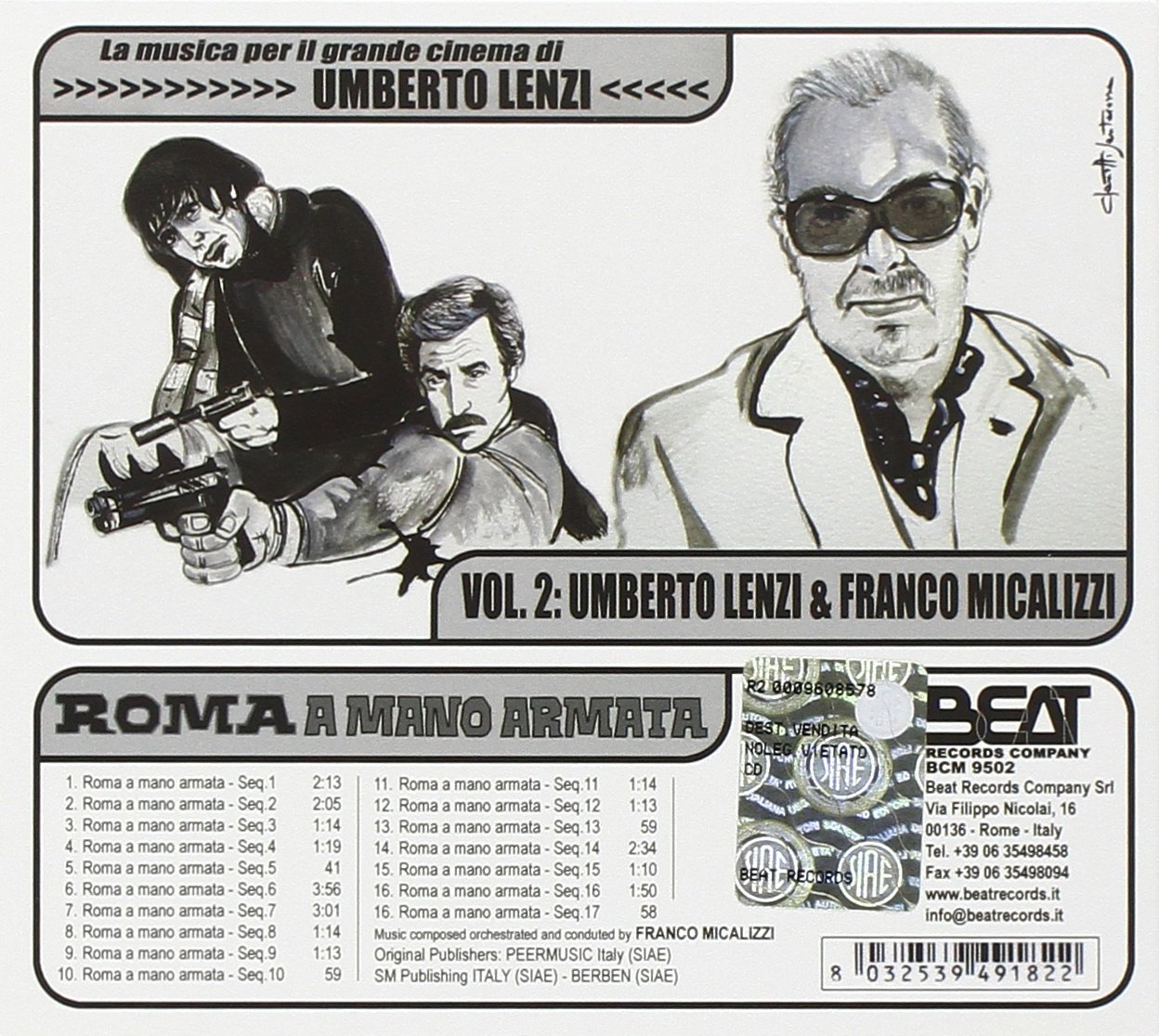
Franco Micalizzi – Roma A Mano Armata (Original Soundtrack) (2011, CD, Italy)


Taken from the 1976 movie directed by Umberto Lenzi.

Inconfondibile. Inarrestabile. Roma A Mano Armata – Seq.1 è tra i temi più famosi della storia del cinema di genere, a uso e consumo per le scene in cui è protagonista il commissario Tanzi. Lo stile di Franco Micalizzi è riconoscibile sin dalle prime note di basso che introducono la partitura pubblicata in cd dalla Beat Records Company. Il sincopato ritmo funk, sostenuto da squillanti interventi di ottoni, è ripreso e variato con flauto, clavinet, organo e sintetizzatori. La tracklist di “Roma A Mano Armata (Original Soundtrack)” (2011) annovera, inoltre, brani atmosferici che commentano, invece, sequenze di tensione: Roma A Mano Armata – Seq.4 sottolinea l’arrivo dei pariolini che aggrediscono una coppietta; Roma A Mano Armata – Seq.7 su misura per l’irruzione in banca attraverso un condotto d’areazione; Roma A Mano Armata – Seq.14 il sottofondo di un momento cult, quando il Gobbo ingoia un proiettile senza battere ciglio.

April 08, 2021

Anekdoten – NEARFest 2000 (2000, 2xCDr, Sweden)


Live soundboard recording of Anekdoten – Live At NEARfest 200 is from June 17, 2000. It was recorded at Baker Hall, Zoellner Arts Center, Lehigh University in Bethlehem, Pennsylvania.

April 05, 2021

Wyatt/Atzmon/Stephen – '..........For The Ghosts Within' (2010, CD, England)


Tracklist:
1. Laura (4:42)
2. Lullaby For Irene (5:53)
3. The Ghosts Within (7:48)
4. Where Are They Now (3:11)
5. Maryan (5:21)
6. Round Midnight (5:47)
7. Lush Life (6:47)
8. What's New? (3:06)
9. In A Sentimental Mood (5:48)
10. At Last I Am Free (2:58)
11. What A Wonderful World (4:52)

Musicians:
Robert Wyatt / lead & backing vocals, percussion, whistling, trumpet (7)
With:
Tali Atzmon / lead (3) & backing (2,3,6) vocals
Abboud Hashem "Stormtrap" / vocals (4)
Gilad Atzmon / soprano (3) & alto (1,6,7,11) saxophones, clarinet (2-5,9,10) & bass (3) clarinet, accordion (3,6), Palestinian shepherd's flute (3), producer & mixing
Frank Harrison / keyboards (3,4,6)
Julian Rowlands / bandoneon (10)
Yaron Stavi / double & electric basses (4)
Richard Pryce / double bass (1-3,5-7,10,11)
The Sigamos String Quartet (1,2,5-11):
Rachel Robson / viola
Ros Stephen / violin and also viola (3,4), backing vocals (2,3,6), string arrangements (1-7,9,10)
Tom Piggot-Smith / violin
Daisy Vatalaro / cello
Jonathan Taylor / string arrangements (8,11)

Confluence – 4 Voyages (1976, LP, France)

Tracklist:
A1 Dakka 5:25
A2 Convergences 11:50
B 4 Voyages 19:00

Musicians:
Contrabass – Didier Levallet
Drums, Percussion – Merzak Mouthana
Guitar – Christian Escoudé
Oboe, Cor Anglais, Flute, Alto Saxophone, Soprano Saxophone – Jean Querlier
Percussion, Drums – Armand Lemal
Violoncello – Jean-Charles Capon

Live recording.
The track "4 Voyages" is a suite with four movements, but without titles or banding.

Quietly gorgeous French jazzy prog vinyl made up of three long (dark, anxious, yet rhythmic and beautiful) tracks, often focused around the wistful cello work of Jean-Francois Capon (cello), whose devastating outfit Baroque Jazz Trio recently had their one eponymous album reissued, and his colleagues Didier Levallet (contrabass) and Armand Lemal (percussion). There are also Christian Escoudé (guitar), Jean Querlier (oboe, flute, saxophones) and Merzak Mouthana (drums). One of France's great undiscovered treasures.

April 02, 2021

Gianfranca Montedoro – Donna Circo (1974, LP, Italy)

gianfranca montedoro & living music
Tracklist:
A1 Donna Circo  2:30
A2 A Cuore Aperto  2:40
A3 A Dodici Metri  2:33
A4 Che Pazzi I Pagliacci  2:26
A5 I Due Giocolieri  2:37
A6 La Cavallerizza  3:20
B1 Trenta Coltelli  3:14
B2 Gli Elefanti Sono Tanti  2:49
B3 La Tigre Del Bengala  2:38
B4 Ma Per Fortuna Al Circo C'È La Banda  1:43
B5 Lo Scontorsionista  2:28
B6 La Grande Parata  3:08

Musicians:
Acoustic Guitar [6 And 12 String], Electric Guitar, Harmonica, Melodica, Tabla – Costantino Albini
Bass Guitar – Mario Garbarino
Drums – Duilio Sorrenti
Electric Guitar, Bass Guitar – Pino Santamaria
Piano, Electric Piano, Synthesizer, Bass Guitar – Piercarlo Zanco
Tam-tam – Alex Serra
Vocals, Music By, Arranged By – Gianfranca Montedoro

Rediscovering Donnacirco, the first Italian Feminist Album
In 1974 the song writer Paola Pallottino and the singer Gianfranca Montedoro recorded the first Italian feminist album. Through the metaphor of the circus, they tell us about the women’s existence in the Seventies. Sadly, Donna Circo has never been released or distributed.
***

Donna Circo è il primo e unico album solista di Gianfranca Montedoro, stampato nel 1974 dall'etichetta discografica BASF Fare ma mai distribuito.

L'album è prodotto da Roberto Marsala. I testi sono di Paola Pallottino.

Concept album ideato dall’autrice Paola Pallottino e dalla musicista-cantante Gianfranca Montedoro, nacque dall’urgenza di analizzare e raccontare problemi e contraddizioni del comune vissuto quotidiano, utilizzando la metafora dei numeri del circo attraverso dodici canzoni.

Scritte di getto, la loro valenza politica è metaforizzata dai singoli contenuti destinati a evidenziare una serie di aspetti della vita delle donne negli anni Settanta.

La prima, Donnacirco, riassume in forma poeticamente iperbolica l’esperienza della condizione femminile, la seconda A cuore aperto allude alla fatale pratica dell’aborto praticato da ‘mammane’ e ‘cucchiai d’oro’ prima della legge del 1978 mentre, A dodici metri, simboleggia l’alterno contrasto e la precarietà del rapporto di coppia.

E se La banda scioglie la tensione con l’umoristica presa d’atto dell’eterno stereotipo della condizione femminile, Gli elefanti rappresenta una sorta di ‘avanti popolo!’ che, nel fare riferimento a l’unione che fa la forza, minaccia quella possibile ribellione alla quale allude il vano tentativo di rivolta femminile ne La tigre del Bengala, con la conseguente repressione che la mano maschile tradurrà nel feroce e ormai rituale ‘femminicidio’. Che pazzi i pagliacci sottolinea lo sguardo beffardo e impietoso che le donne rivolgono a una società irrimediabilmente fallocratica. I due giocolieri riprende il tema della logorante fatica dell’equilibrio quotidiano mentre, Trenta coltelli, allude al pericolo della convivenza in mancanza d’amore, così come La cavallerizza rappresenta una riflessione sulla solitudine e sulla trappola della fissazione amorosa. Lo scontorsionista è un chiaroveggente pamphlet che anticipa la figura del socialista così come si sarebbe sviluppata in era craxiana. Infine, La grande parata, che Gianfranca Montedoro interpreterà con la struggente invenzione dei successivi strumenti musicali a levare, rappresenta la grande giostra della vita che intreccia inganni, debolezze e menzogne. (wikipedia)

April 01, 2021

Subversion – Subversion (1976, LP, France)


Tracklist:
A1 L'Arbre Mort  5:18
A2 Kaliani  4:31
A3 Mektoub  3:47
A4 Le Tube De L'Ete  3:39
B1 Reverie  4:23
B2 Mort D'Un Rat  3:43
B3 4, 5, 6  3:03
B4 Jazz From Sarcelles  2:06
B5 Submersion  2:03

Musicians:
Bass, Vocals – M. Chiarutini
Cello – E. Bailen
Drums – P. Smadja
Electric Piano, Keyboards – J. Hurel
Guest, Grand Piano – F. Giblat
Guest, Guitar – M. Perier, M. Bonnecarrère
Guest, Keyboards – P. Govin
Guitars – E. Mallet, J.L. Fauvel
Tenor Saxophone, Soprano Saxophone – P.J. Gidon


Another of those obscurities on the Pôle label, Subversion were an odd one, in that every track on their album ventured to a different genre, and sometimes within a track they'd explore musics one wouldn't normally put together. We have folk, Ange style prog, Canterbury style fusion, jazz, breezy calypso, pop, symphonic classical prog, and I guess you get the idea - an album that doesn't gel at all. Experimental in parts, I guess, with some brief moments of brilliance, but was too varied for its own good! (ultimathulerecords)